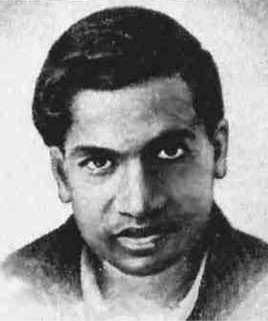
Srinivasa Ramanujan was born in 1887 at Erode and grew up in Kumbakonam in a poor Brahmin family; his father was a clerk in a cloth shop and his mother sang at the local temple. At fifteen he found a copy of G. S. Carr's Synopsis of Pure Mathematics, a list of thousands of results without proofs, and taught himself from it, filling notebooks with his own discoveries.
“An equation for me has no meaning unless it expresses a thought of God.”Attributed to Ramanujan
Absorbed in mathematics, he failed his other college subjects twice and lost his scholarship. For years he lived in poverty until, in 1912, he found work as a clerk at the Madras Port Trust.
The letter to Hardy
In January 1913 Ramanujan wrote to G. H. Hardy, a leading mathematician at Cambridge, enclosing pages of formulas. Hardy at first suspected a hoax, then realised that some results "must be true, because if they were not true, no one would have had the imagination to invent them". He invited Ramanujan to England. Ramanujan, an orthodox Brahmin, hesitated to cross the sea; tradition says his mother dreamt that the goddess Namagiri gave her blessing.
Cambridge
From 1914 to 1919 Ramanujan worked with Hardy and J. E. Littlewood at Trinity College. His work on partitions — the number of ways a number can be written as a sum — with Hardy produced a celebrated exact formula, and he made deep discoveries on infinite series, continued fractions, highly composite numbers and the values of π. In 1918 he became one of the youngest Fellows of the Royal Society and the first Indian Fellow of Trinity College.
Visiting him in hospital, Hardy remarked that his taxi number, 1729, was dull; Ramanujan replied at once that it was very interesting — the smallest number expressible as the sum of two cubes in two different ways.
Return and the lost notebook
Weakened by illness and the English diet, Ramanujan returned to India in 1919 and died in Kumbakonam on 26 April 1920, aged thirty-two. In his last year he wrote about "mock theta functions", which mathematicians understood only decades later. A bundle of his final pages, the "lost notebook", was rediscovered in 1976; mathematicians are still proving and applying his results.
How they are remembered
India observes his birthday, 22 December, as National Mathematics Day. The SASTRA Ramanujan Prize honours young mathematicians, and his life is told in the book and film The Man Who Knew Infinity.
Ekatmata Stotra · Stanza 26
Named in Stanza 26 of the Ekatmata Stotra — bridging the ancient and the modern.
नागार्जुनो भरद्वाजः आर्यभट्टो वसुस्तथा।
रमणो रामानुजश्च नवदीप्त्या विराजिताः॥
Sources: Wikipedia: Srinivasa Ramanujan · Wikipedia: 1729 (number). Written afresh for The Hindu Book; corrections welcome at [email protected].