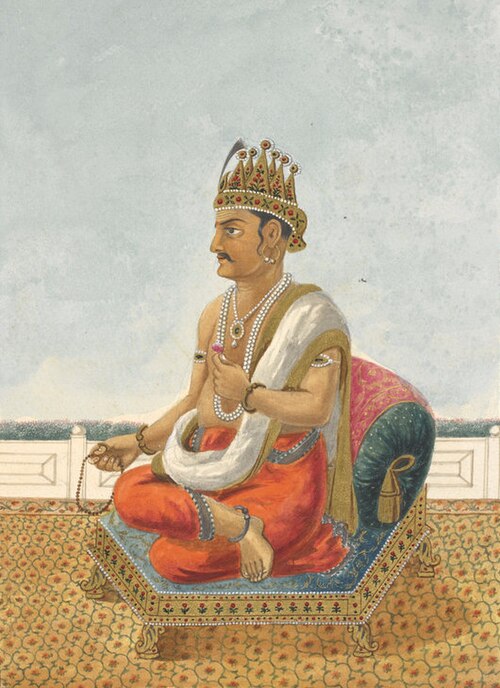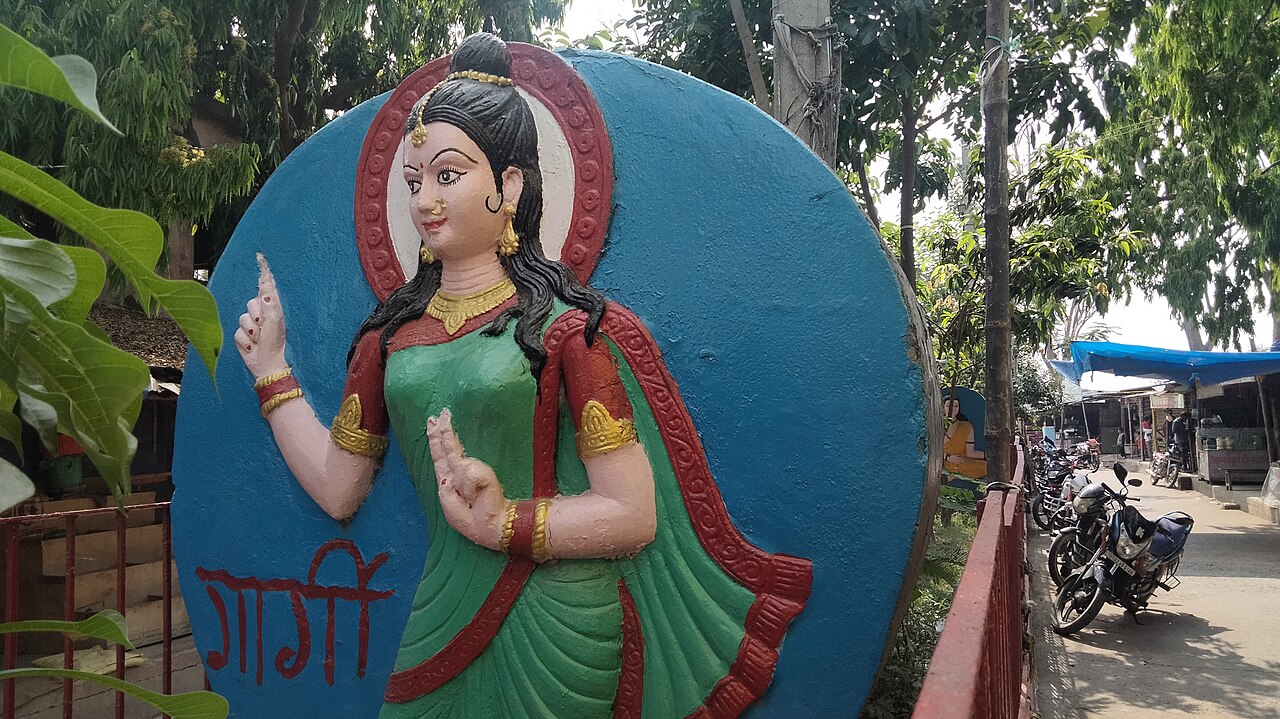
Gargi is known to us from the Brihadaranyaka Upanishad, one of the oldest and greatest of the Upanishads, usually dated to around the 7th or 6th century BCE. Her name tells us that she was of the Garga lineage and the daughter of a man named Vachaknu. The tradition calls her a brahmavadini — a woman devoted to the study and discussion of Brahman.
यदूर्ध्वं याज्ञवल्क्य दिवो यदवाक्पृथिव्या यदन्तरा द्यावापृथिवी इमे यद्भूतं च भवच्च भविष्यच्चेत्याचक्षते कस्मिंस्तदोतं च प्रोतं चेति“That which is above the sky, Yajnavalkya, and below the earth, and between the two — that which they call past, present and future: across what is it woven, warp and woof?”Brihadaranyaka Upanishad 3.8.3
The Ashvalayana Grihya Sutra lists Gargi Vachaknavi, along with Vadava Pratitheyi and Sulabha Maitreyi, among the teachers to whom offerings are made in the daily remembrance of the rishis — a sign of how highly she was regarded.
Janaka's assembly
The third chapter of the Brihadaranyaka tells that King Janaka of Videha held a great sacrifice and set aside a thousand cows with gold tied to their horns as a prize for the most learned of the brahmins present. When no one dared claim them, Yajnavalkya told his pupil to drive them home. The others challenged him, and one after another the leading scholars questioned him — and fell silent.
The first questions
Gargi rose in her turn (3.6). Everything here is woven on water, she said — but on what is water woven? On air, answered Yajnavalkya. On what is air woven? On the intermediate space. She pressed him through world after world — of the gandharvas, the sun, the moon, the stars, the gods, Indra, Prajapati — until he reached the worlds of Brahman. When she asked what those were woven on, he warned her: Gargi, do not question too far, lest your head fall off. You are questioning about a deity beyond which there can be no questioning. She fell silent.
Two arrows
Later in the debate (3.8) Gargi asked the assembly's leave to question him again. She would put two questions to him, she said, like a warrior of Kashi or Videha who strings his bow and comes forward with two piercing arrows in hand. If he could answer them, no one in the assembly would ever defeat him.
Her first question, across what all of space and time is woven, he answered: across space (akasha). Her second: across what is space itself woven? Yajnavalkya then gave one of the most celebrated teachings of the Upanishads — the Akshara, the Imperishable, which is neither gross nor fine, neither short nor long, without shadow or darkness, without inside or outside; at whose command, Gargi, the sun and moon stand apart, and heaven and earth are held in place. Unseen, it sees; unheard, it hears.
Gargi turned to the assembly and told them they should count themselves fortunate to escape by paying him homage, for none of them would ever defeat him in argument about Brahman.
Yajnavalkya answers no other challenger with this teaching of the Akshara; it is Gargi's persistence that draws it out. Elsewhere in the same Upanishad another woman, Maitreyi, Yajnavalkya's wife, asks him what use wealth is if it cannot bring immortality — and the two together show that women took part in the highest inquiry of the age.
How they are remembered
Gargi has become a lasting symbol of women's learning in ancient India — a woman who spoke as an equal in the most demanding philosophical assembly of her age, and whose questions drew out the Upanishad's highest teaching. Schools, colleges and awards across India bear her name, and she stands in the Ekatmata Stotra among the great mothers of the nation.
Ekatmata Stotra · Stanza 10
Named in Stanza 10 of the Ekatmata Stotra — ten women of itihāsa and purāṇa.
अरुन्धती अनसूया च सावित्री जानकी सती।
द्रौपदी कण्णगी गार्गी मीरा दुर्गाश्च वन्दिताः॥
Sources: Wikipedia: Gargi Vachaknavi · Wikipedia: Brihadaranyaka Upanishad · wisdomlib.org/hinduism/book/the-brihadaranyaka-upanishad. Written afresh for The Hindu Book; corrections welcome at [email protected].