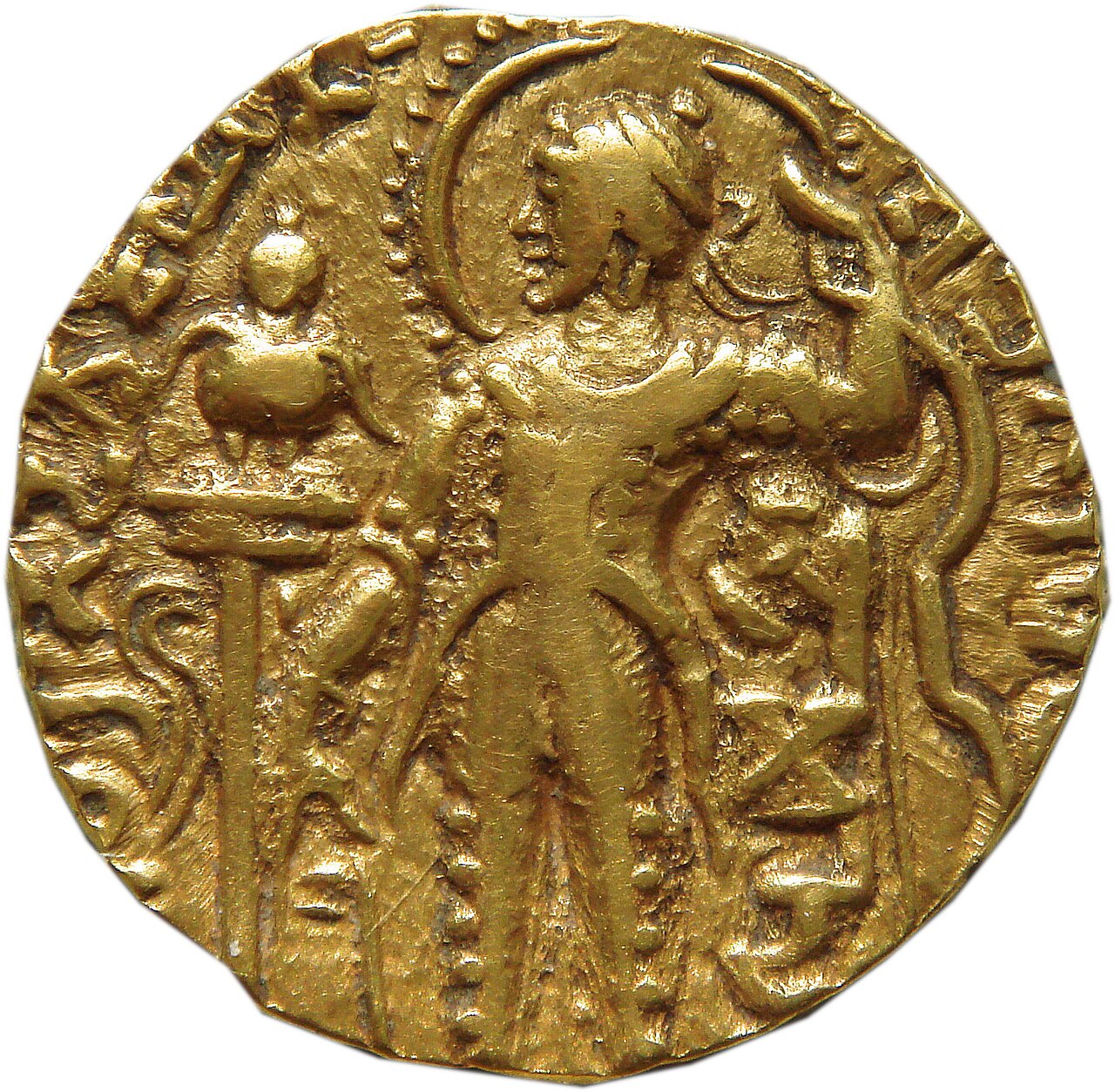
Samudragupta was the son of Chandragupta I, the founder of the Gupta empire, and of Queen Kumaradevi, a princess of the Lichchhavi clan. The Guptas were proud of this marriage: their gold coins show the couple together, and Samudragupta's inscriptions call him Lichchhavi-dauhitra, "grandson of the Lichchhavis". According to his court inscription, his father chose him as heir before an assembly, embracing him with the words, as the poem gives them, "Noble one, protect the earth."
राजाधिराजः पृथिवीमवित्वा दिवं जयत्याहृतवाजिमेधः"The king of kings, having protected the earth, wins heaven — he who has performed the horse sacrifice."Legend on Samudragupta's Ashvamedha-type gold coins
His reign is usually placed between about 335 and 375 CE, though historians differ by a decade or more at both ends. Almost everything we know about him comes from his own inscriptions and coins, so the picture is detailed but also, naturally, flattering.
The Allahabad pillar
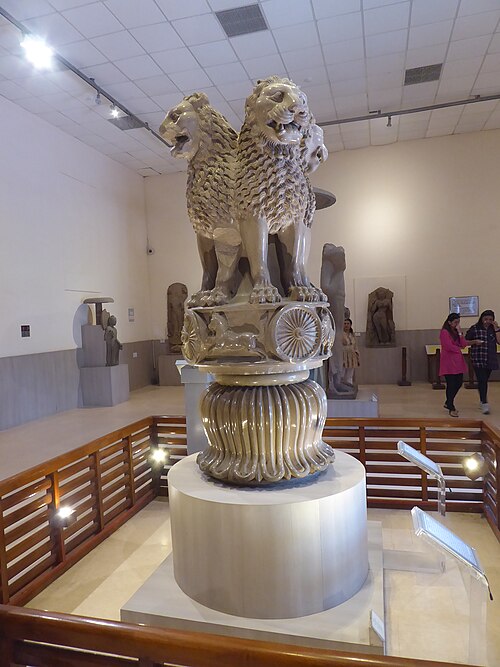
The main record of his reign is a long Sanskrit poem in praise of him — a prashasti — composed by his minister and court poet Harishena. It was carved on the same polished sandstone pillar that already bore edicts of Ashoka, and the pillar now stands in the fort at Prayagraj. Written partly in verse and partly in ornate prose, it is one of the finest pieces of early classical Sanskrit and our chief source for his wars.
A second, shorter inscription of his reign survives at Eran in Madhya Pradesh, where he is said to have founded a town and set up a shrine.
The campaigns
Harishena lists the conquests in groups. In Aryavarta, the northern plains, nine kings are named as "violently uprooted", and their lands were taken into the empire. In Dakshinapatha, the south, twelve kings — from Kosala and the forest country down to Kanchi on the Tamil coast — were captured and then released and restored, a policy the inscription calls seizing, freeing and favouring. The forest chiefs were made his servants.
Beyond these, the frontier kingdoms of Samatata, Davaka, Kamarupa, Nepala and Kartripura, and tribal republics such as the Malavas, Arjunayanas, Yaudheyas, Madrakas and Abhiras, are said to have paid tribute and obeyed his orders. The inscription also claims that distant rulers — the Kushana "Daivaputra Shahi Shahanushahi", the Shakas, and the island of Simhala — sent gifts and sought his favour. Historians accept the northern and southern campaigns but read these last claims as diplomacy rather than conquest. A Chinese source records that King Meghavarna of Sri Lanka did seek his permission to build a monastery for Sri Lankan pilgrims at Bodh Gaya.
Poet, musician, sacrificer
Harishena praises Samudragupta not only as a warrior but as a man of letters, calling him Kaviraja, "king of poets", and saying he put Narada and Tumburu to shame with his music. His coins bear this out: one type shows the emperor seated on a couch, playing the veena. After his wars he performed the Ashvamedha, the Vedic horse sacrifice, and issued gold coins showing the sacrificial horse before a post, with the queen on the reverse.
He was a devotee of Vishnu, and Garuda, Vishnu's mount, appears as the royal emblem on his coins and seals.
"Napoleon of India"
In the early twentieth century the historian V. A. Smith called him the "Indian Napoleon", and the phrase stuck in textbooks. Later historians have pointed out its limits: Samudragupta did not try to rule everything he conquered directly, and his treatment of the southern kings was closer to the old Indian ideal of dharma-vijaya — victory followed by restoration — than to annexation.
How they are remembered
Samudragupta built the political frame within which the Gupta age flourished under his son Chandragupta II: a large, stable state in which Sanskrit literature, temple building, mathematics and astronomy reached a classical form. The pillar at Prayagraj, carrying both Ashoka's edicts and Harishena's poem, still stands as a record of two great empires on one stone.
Ekatmata Stotra · Stanza 22
Named in Stanza 22 of the Ekatmata Stotra — the architects of empire — Chanakya to Bappa Rawal.
चाणक्यश्च चन्द्रगुप्तो विक्रमादित्यशालिवाहनौ।
समुद्रगुप्तो हर्षः शैलेन्द्रो बप्पारावलः॥
Sources: Wikipedia: Samudragupta · Wikipedia: Allahabad Pillar. Written afresh for The Hindu Book; corrections welcome at [email protected].