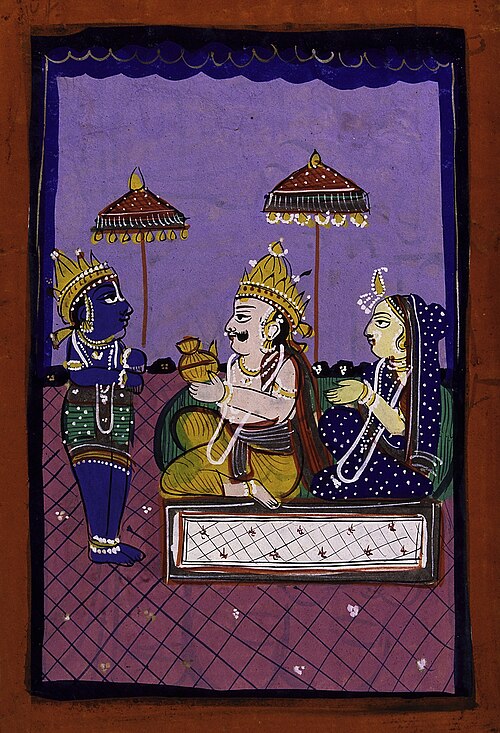
Shibi, also written Shivi, was a king of the Ushinara line, and his name is linked with the Shibi people of the ancient northwest. The Mahabharata tells his story more than once, most fully in the Vana Parva, where the sage Lomasha narrates it to the Pandavas on pilgrimage, and again in the Shanti and Anushasana Parvas. Versions also appear in the Puranas and, in a different form, in Buddhist literature.
“This bird came to me in fear, seeking shelter. I will not give up one who has taken refuge with me — take my own flesh instead.”Shibi to the hawk, Mahabharata, Vana Parva — paraphrased
In every version he is the king who would rather lose his own body than break the promise of protection. He is the classic example of sharanagata-raksha, protecting one who seeks refuge.
The hawk and the dove
The Mahabharata tells that the gods wished to test the king. Agni took the form of a dove and Indra the form of a hawk. Pursued by the hawk, the terrified dove flew into Shibi's lap as he sat in his court and begged for protection.
The hawk landed and demanded its prey. It argued that the dove was its rightful food, that it was hungry, and that by keeping it from him the king would let a creature starve — which would be against dharma too. Shibi offered the hawk any other food, even a bull or a boar, but the hawk refused. At last it agreed to accept an amount of the king's own flesh equal in weight to the dove.
The scales
Shibi had a pair of scales brought and set the dove on one side. He cut flesh from his own body and placed it on the other, but the dove grew heavier and heavier. However much he cut, the scale did not move. Finally, the epic says, the king climbed onto the scale himself, offering his whole body.
Then the gods revealed themselves. Indra and Agni praised Shibi, healed his body, and told him that his fame would last as long as people speak of him. Some versions say a divine voice proclaimed him the greatest among protectors.
The Mahabharata lets the hawk make a serious case, and the dialogue is part of the story's point. Dharma is not simple: to protect one creature may harm another. Shibi does not deny the hawk's hunger; he answers it by paying the cost himself rather than shifting it onto the helpless.
Other tellings
The Mahabharata contains more than one version, with differences in the details — in one, he is asked to sacrifice his own son to feed a Brahmin guest, and does not refuse. The story also travelled into Buddhism. In the Sivi Jataka, King Sivi, a former life of the Buddha, gives his own eyes to a blind Brahmin who is Sakka (Indra) in disguise, and the gift is rewarded with eyes of truth; the hawk-and-dove version also appears in Buddhist art and texts. Carvings of Shibi's sacrifice survive at Amaravati, Gandhara and Borobudur, showing how far the story spread.
How they are remembered
Shibi's name became proverbial for self-sacrifice in protecting the weak. Tamil literature, including the Sangam poems, speaks of a Chola ancestor who saved a dove, and Tamil kings claimed descent from Sembiyan, the one who saved the dove. The story still sums up a deep Indian ideal: once protection is promised, it must be kept at any cost.
Ekatmata Stotra · Stanza 14
Named in Stanza 14 of the Ekatmata Stotra — six figures of sacrifice and dharma.
भगीरथश्च एकलव्यो मनुर्धन्वन्तरिस्तथा।
शिबिश्च रन्तिदेवश्च दर्शितं धर्म-लक्षणम्॥
Sources: Wikipedia: Shibi (king) · Wikipedia: Sivi Jataka. Written afresh for The Hindu Book; corrections welcome at [email protected].