Ekalavya's story is told briefly in the Adi Parva of the Mahabharata. He was the son of Hiranyadhanus, a chief of the Nishadas, a forest-dwelling people. Hearing of Drona, the great teacher of archery to the Kuru princes, he came to Hastinapura and asked to become his pupil. Drona refused him, the epic says, because he was a Nishada.
“Tell me what you wish, lord. There is nothing I would not give my teacher.”Ekalavya to Drona, Mahabharata, Adi Parva (1.123 in the critical edition) — paraphrased
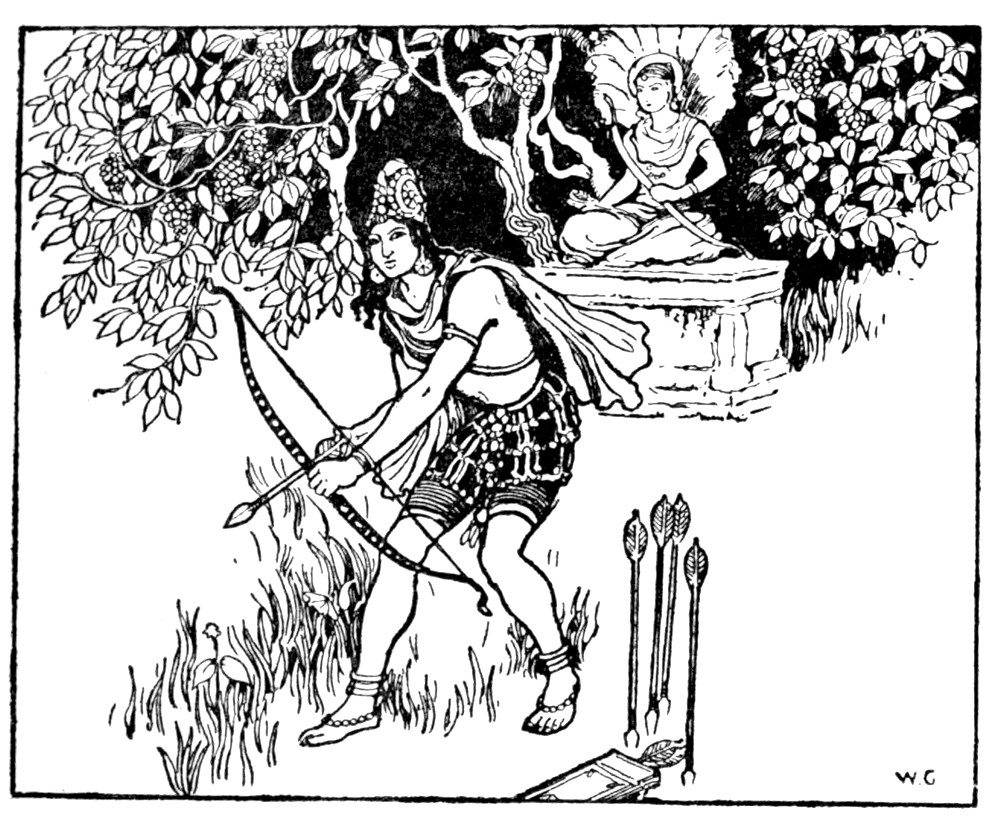
Ekalavya did not give up. He bowed to Drona, went back to the forest, made a clay image of the teacher, and practised archery before it day after day as though Drona himself were watching. Through devotion and discipline he became a master.
The dog and the seven arrows
One day, the Mahabharata tells, the Kuru and Pandava princes went hunting in the forest with a dog. The dog came upon Ekalavya, dark and dressed in deerskin, and barked at him. Without harming it, Ekalavya shot seven arrows into its mouth at once, silencing it. The dog ran back to the princes, who were amazed at the skill this showed.
They found the archer, who told them he was a pupil of Drona. Arjuna, to whom Drona had promised that no pupil would ever surpass him, went to his teacher troubled and asked how a forest archer could be better than he was.
The epic presents Drona's refusal briefly and without comment. It notes that Drona was bound to the Kuru princes as their household teacher, and that he had already promised Arjuna pre-eminence, but it leaves the reader to judge his motives. Ekalavya's response, however, is drawn clearly: he holds no grudge, and turns refusal into devotion.
The guru-dakshina
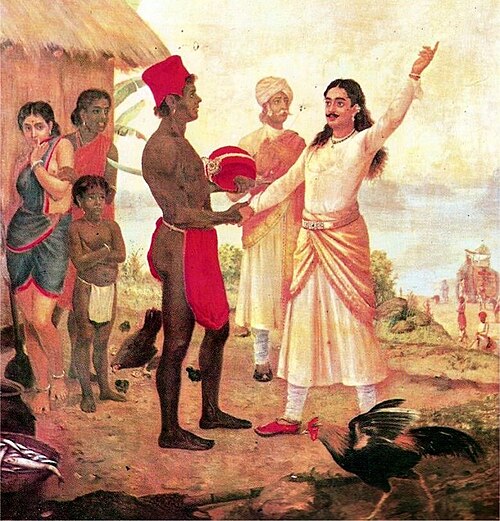
Drona went with Arjuna to the forest. Ekalavya fell at his feet and welcomed him as his teacher. Drona said that if Ekalavya was his pupil, he must pay the teacher's fee, guru-dakshina. Ekalavya gladly agreed to give anything. Drona asked for the thumb of his right hand.
The epic says Ekalavya, with a cheerful face and without hesitation, cut off his thumb and gave it to Drona. Afterwards he could still shoot, but no longer with his former speed. Arjuna's anxiety was relieved, and Drona's promise to him was kept.
Two ways of reading the story
For many centuries the tradition has held up Ekalavya as the supreme example of guru-bhakti: a pupil whose devotion was so complete that a clay image could teach him, and who gave his most precious skill without a word of complaint. That is why he is named in the Ekatmata Stotra.
Modern readers, and many writers from tribal and Dalit communities, also read the episode as a story of exclusion and injustice — a gifted youth turned away for his birth and then disabled to protect a royal favourite. Both readings take Ekalavya's greatness seriously; they differ on what the story says about Drona. Later texts such as the Harivamsha mention Ekalavya again, fighting on the side of Jarasandha, and versions of his end differ.
How they are remembered
Ekalavya remains one of the most discussed figures in the epic. The Government of India's Eklavya Model Residential Schools for tribal students carry his name, as do sports awards in several states. He stands for the power of self-discipline and devotion — and as a reminder that talent can come from anywhere.
Ekatmata Stotra · Stanza 14
Named in Stanza 14 of the Ekatmata Stotra — six figures of sacrifice and dharma.
भगीरथश्च एकलव्यो मनुर्धन्वन्तरिस्तथा।
शिबिश्च रन्तिदेवश्च दर्शितं धर्म-लक्षणम्॥
Sources: Wikipedia: Ekalavya · Wikipedia: Drona · Wikipedia: Eklavya Model Residential School. Written afresh for The Hindu Book; corrections welcome at [email protected].