The fullest account of Prahlada is in the seventh book of the Bhagavata Purana; the Vishnu Purana and others tell it too. His father, the daitya king Hiranyakashipu, hated Vishnu, who as Varaha had killed his brother Hiranyaksha. By fierce austerity he won from Brahma a boon that he could not be killed by man or beast, inside or outside, by day or by night, on the ground or in the sky, by any weapon — and he made himself master of the three worlds.
श्रवणं कीर्तनं विष्णोः स्मरणं पादसेवनम्। अर्चनं वन्दनं दास्यं सख्यमात्मनिवेदनम्॥“Hearing of Vishnu, singing of him, remembering him, serving his feet, worshipping him, bowing to him, serving him, befriending him, and offering oneself wholly to him.”Bhagavata Purana 7.5.23 — Prahlada to his father, the nine forms of bhakti
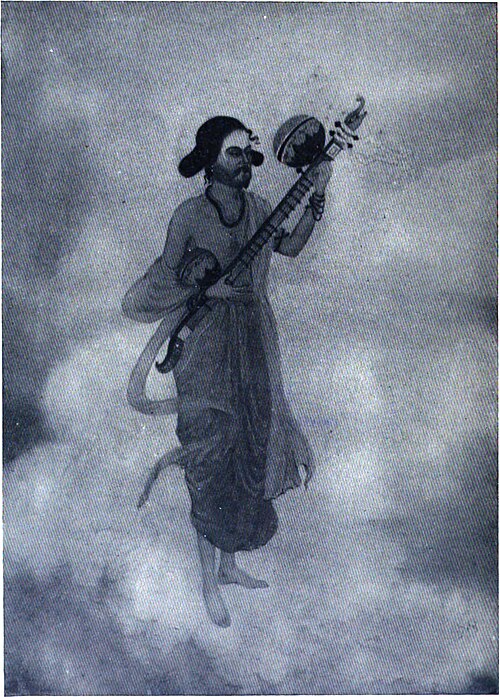
While he was away at his tapas, the Bhagavata says, his pregnant wife Kayadhu was sheltered by the sage Narada, and the child in her womb absorbed Narada's teaching of devotion. Prahlada was born a devotee of Vishnu.
The pupil who would not learn
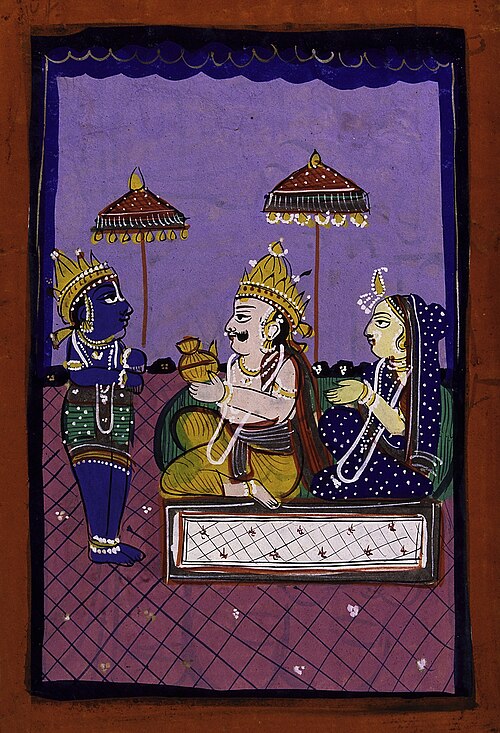
Hiranyakashipu sent his son to be taught statecraft by Shanda and Amarka, sons of the asura guru Shukracharya. When the king asked the boy what was the best thing he had learnt, Prahlada answered with the nine forms of devotion to Vishnu. Furious, the king blamed the teachers; but Prahlada was teaching his classmates the same devotion during their play.
The trials
The Bhagavata and Vishnu Puranas tell how Hiranyakashipu ordered his son killed. Demons struck him with weapons; he was trampled by elephants, bitten by serpents, given poison, thrown from a height, cast into fire and into the sea. Each time, thinking of Vishnu, he was unharmed.
The popular story of Holika — Hiranyakashipu's sister, who had a boon against fire and sat with Prahlada in a blaze, only to be burnt herself while he walked out unharmed — is not in the Bhagavata, but it is told in later texts and across India as the origin of the Holika bonfire on the eve of Holi.
The Vishnu Purana adds that he was bound and cast into the sea with mountains heaped upon him. There, meditating on Vishnu as present in all things, he found himself free. Its lesson, repeated throughout his story, is that the Lord he praised is not far away but within every being — even those who sought to kill him.
Narasimha
At last the king demanded where this Vishnu was. Everywhere, said Prahlada. "Is he in this pillar?" Hiranyakashipu struck it — and from the pillar, the Bhagavata says, came Narasimha, neither man nor beast but man-lion. At twilight, neither day nor night, on the threshold, neither inside nor outside, holding the king on his lap, neither earth nor sky, he tore him apart with his claws, which were no weapon. Every condition of Brahma's boon was kept.
Not even the gods dared approach the raging Narasimha. Brahma sent Prahlada, who bowed and sang a hymn of praise (Bhagavata 7.9), and the Lord grew calm and took him on his lap. Offered any boon, Prahlada asked only that he never desire anything — and that his father be forgiven.
How they are remembered
Prahlada ruled the daityas righteously, and the Puranas make him the grandfather of the generous King Bali. He is the model of the devotee whose faith does not depend on age, birth or circumstance. Narasimha Jayanti marks the Lord's appearance for him, and the Holika fire is lit each year in memory of his deliverance.
Ekatmata Stotra · Stanza 12
Named in Stanza 12 of the Ekatmata Stotra — ten figures from the great epics.
रामो भरतश्च कृष्णो भीष्मो धर्मपुत्र: तथा।
अर्जुनो मार्कण्डेय: हरिश्चन्द्र: प्रह्लादो नारदस्तथा॥
Sources: Wikipedia: Prahlada · Wikipedia: Narasimha · vedabase.io/en/library/sb/7/5/23. Written afresh for The Hindu Book; corrections welcome at [email protected].