Prithu, called Vainya as the son of King Vena, appears already in the Vedic literature as a seer and as the first anointed king; the Shatapatha Brahmana calls him the first of men to be consecrated. The Mahabharata, the Vishnu Purana and above all the fourth book of the Bhagavata Purana tell his story at length, and the Bhagavata counts him as a partial avatar of Vishnu.
न कामये नाथ तदप्यहं क्वचिन्न यत्र युष्मच्चरणाम्बुजासवः। महत्तमान्तर्हृदयान्मुखच्युतो विधत्स्व कर्णायुतमेष मे वरः॥“Lord, I do not want even liberation if it lacks the nectar of your lotus feet that flows from the lips of great devotees. Give me ten thousand ears — that is the boon I ask.”Bhagavata Purana 4.20.24 — Prithu's reply when Vishnu offers him a boon
He matters to the tradition as the archetype of kingship. In Prithu's story the king is not a conqueror but a guardian, whose duty is to make the land fruitful and to protect every creature on it.
Born from a tyrant's body
The Puranas tell that King Vena, Prithu's father, was a cruel and godless ruler who forbade sacrifice and declared himself the only object of worship. The sages, after failing to reform him, struck him down. With no king, the land fell into chaos. So the sages churned the body of the dead king: from his thigh came a dark, short figure who was sent away, and from his arms came a radiant pair, Prithu and his wife Archi. The Bhagavata says Prithu bore the marks of Vishnu on his hands and feet.
At his coronation the gods brought gifts and the sages anointed him, and the bards began to sing his praises. Prithu stopped them, saying he had done nothing yet worth praising.
Milking the earth
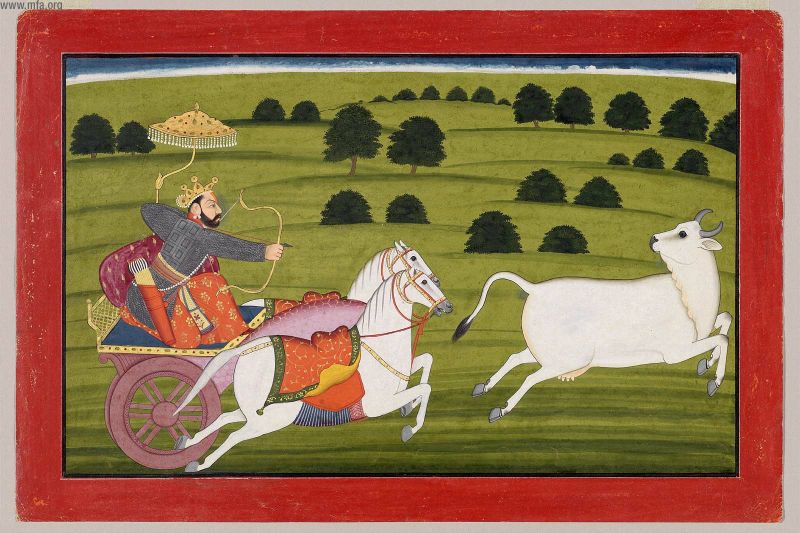
The most famous episode follows. Famine gripped the land, because the earth had withheld her plants and grains. Prithu took up his bow to force her, and the earth fled in the form of a cow. Cornered, she pleaded with him: she had hidden the seeds because evil rulers had misused them, and if he would give her a calf and a vessel, she would give her milk to all.
Prithu made Svayambhuva Manu the calf and milked from her the grains and plants for humankind. Then, the Bhagavata and Vishnu Purana say, each class of being milked her in turn with its own calf and vessel — the sages, the gods, the ancestors, the mountains, the trees — so that every creature received its proper nourishment.
Levelling the land
The texts say Prithu then levelled the earth's surface with the tip of his bow, and that before him there were no villages, towns, farms, pastures or roads. He laid them out and settled people in them. Because he cared for her like a father, the earth took his name: Prithvi, the daughter of Prithu. The Bhagavata also tells how he performed a hundred horse-sacrifices, made peace with a jealous Indra, and at the end went to the forest with Archi for tapas.
Prithu's reign in the Bhagavata includes a famous address to his subjects, in which he says that a king who collects taxes without protecting his people takes on their sins, and that he rules only so that all may live by dharma. When Vishnu appears and offers him a boon, he asks only for ten thousand ears with which to hear the Lord's glories.
How they are remembered
Prithu offers one of India's oldest images of good government: a ruler who serves, who refuses unearned praise, and who works with the earth rather than against it. Every time Indians call the earth Prithvi, his name is spoken.
Ekatmata Stotra · Stanza 13
Named in Stanza 13 of the Ekatmata Stotra — eleven devotees, sages and seers.
हनुमान् जनको व्यासो वसिष्ठः शुको बलि: तथा।
दधीचिर्विश्वकर्मा च पृथु: वाल्मीकिरेव च॥
Sources: Wikipedia: Prithu · vedabase.io/en/library/sb/4/20/24 · Wikipedia: Vena (king). Written afresh for The Hindu Book; corrections welcome at [email protected].